Econoday’s Relative Economic Performance Index (RPI) remained sub-zero last week. At minus 14, the current reading signals recent global economic activity slightly lagging despite limited positive contributions from the U.S., UK and Japan.
With the notable exception of inflation, last week’s U.S. economic data were mainly a little softer than forecast. However, in terms of the big picture, the RPI (3) remained just above zero while the RPI-P (exactly zero) showed real side activity moving bang in line with forecasts. As such, the odds would seem to remain against a second successive 50 basis point cut by the Federal Reserve in November.
In Canada, an unexpectedly firm September employment report saw the RPI close out the week at minus 9, indicating just very modestly underperforming economic activity. Forecasters are split over whether the Bank of Canada will cut interest rates by 25 basis points or a full 50 basis points next week but Wednesday’s September CPI report should make the outlook a little clearer.
In the Eurozone, economic data continue to add to pressure on the European Central Bank to cut key interest rates again on Thursday. At minus 9 and minus 1 respectively, the region’s RPI and RPI-P are only just in negative surprise territory but activity has fallen short of expectations for almost the entire period since the September policy announcement.
In the UK, Friday’s data basket was strong enough to keep both the RPI (23) and RPI-P (22) clearly above zero. Current readings reduce pressure on the Bank of England to lower Bank Rate again next month but this week’s key CPI and labour market reports could easily change all that.
At exactly zero, the Swiss RPI shows recent economic activity matching market expectations although the RPI-P (17) remains quite well above zero. The difference between the two continues to reflect downside surprises on inflation, ensuring that speculation about the Swiss National Bank easing again in December remains very much alive.
In Japan, unexpectedly firm household spending and pipeline inflation kept the RPI (9) and RPI-P (18) above zero. The general election later this month has dampened speculation about the Bank of Japan tightening in October but, on current trends, a move in December remains a real possibility.
There were no important Chinese releases last week, leaving both the RPI and RPI-P at a lowly minus 50. Despite the central bank’s sizeable monetary stimulus in late September, such readings may well mean that the disappointingly limited fiscal package announced by the government last week will have to be bolstered.
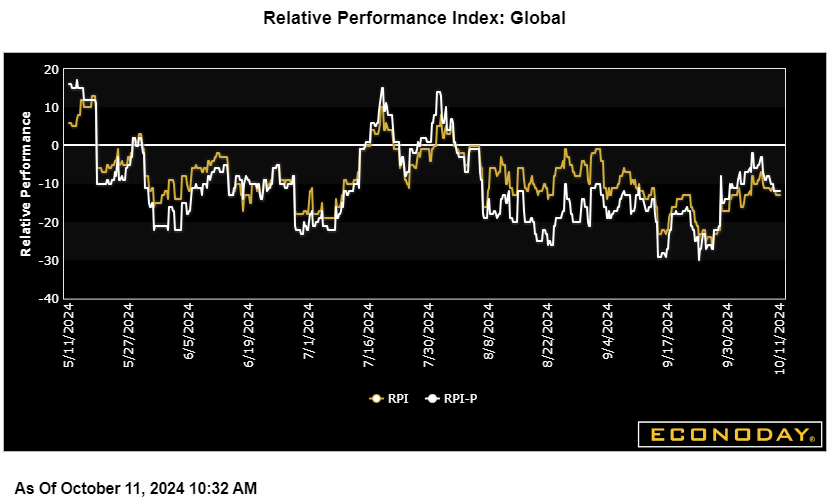
Econoday’s RPI provides a handy summary measure of how an economy has recently been evolving relative to market expectations.
A reading above zero means that the economy in general has been performing more strongly than expected and vice versa for a reading below zero. The closer is the value to the maximum (+100) or minimum (-100) levels, the greater is the degree to which markets have been under- or over-estimating economic activity. A zero outturn would imply that, on average, the market consensus has been correct. Note too that the index is sensitized to place extra weight upon those indicators that investors consider to be the most important.