In the final full week before the presidential election on Tuesday, November 5, it may be hard for any single data report to break through the noise. However, there are two reports that should rise above the clamor. Any surprises to the up- or down-side will get politicized in on social media, but this should be short-lived in the final days as the candidates make their respective cases to voters.
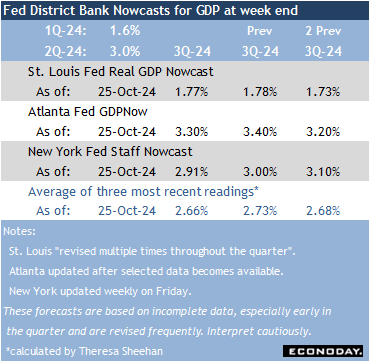
The advance estimate for third quarter GDP is at 8:30 ET on Wednesday. Growth of around 2.5 to 3.0 percent seems likely, which is little different from the up 3.0 percent in the second quarter. The three GDP Nowcasts from the New York, St. Louis, and Atlanta Feds forecast growth at 2.91 percent, 1.77 percent, and 3.30 percent, respectively. Historically, the Atlanta Fed forecast has the strongest correlation with the actual result. In any case, solid consumer spending should keep modest growth on track.
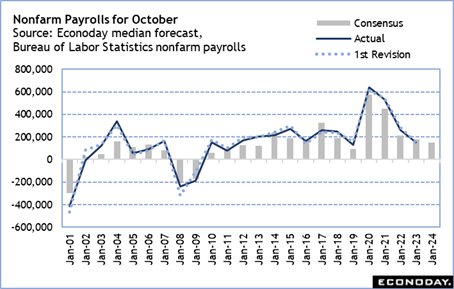
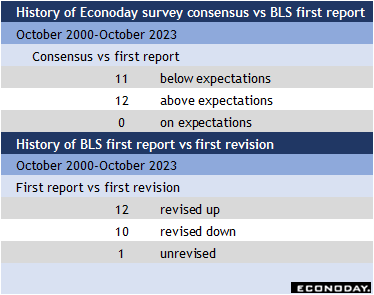
The monthly employment report is at 8:30 ET on Friday. Early forecasts look for about a 150,000 rise in payrolls for October. There are two special factors that might lead to a surprise.
The first is Hurricane Helene’s impact on large parts of the Southeast. Widespread devastation can make it difficult for the statistical agency to collect the normal data. Establishments may be hard to contact and unusual circumstances make it difficult to answer the standard questions. The same can be true of the household survey side. The BLS has experience dealing with this sort of challenge, but it may have an impact nonetheless. It may also result in more revisions than usual when the November data is released on December 6 at 8:30 ET.
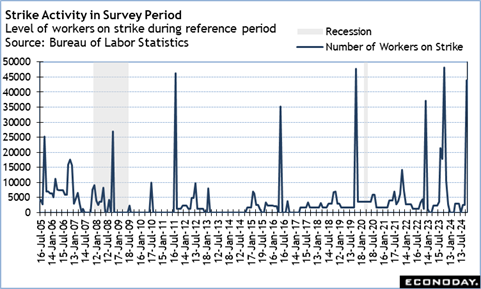
The second is strike activity. There is two new strikes in aerospace that affects 38,000 workers. These workers will be deducted from October manufacturing payroll counts. Additionally, there is a new strike of 3,400 hotel workers which will be deducted from leisure and hospitality payrolls. These one-time impacts. They will be added back in once each strike is settled, whenever that is. However, the strikes at Boeing and Textron may result in some layoffs and/or delays in hiring at businesses that are part of the chain of goods and services for aircraft manufacture. Businesses are reluctant to lose workers now who may be harder and/or most costly to replace later. But if the strike drags on, there could be effects in the coming weeks or months.