The employment report for December confirms the other data related to the labor market. New hiring is largely confined to private education and healthcare, and leisure and hospitality. The service-providing sector is outperforming goods-producers, but only slightly. Businesses are retaining their current workers on payroll but most are only filling essential openings rather than expanding employment. The job market remains competitive for workers with the right skills and/or experience, but opportunities are otherwise limited.
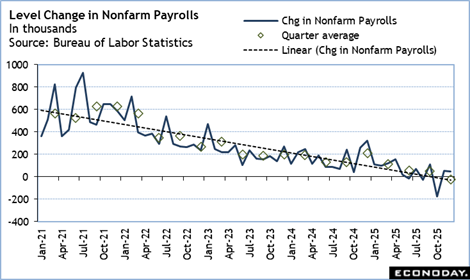
Nonfarm payrolls are up 50,000 in December on top of a net downward revision to the prior two months of 76,000. This brings the monthly average change in nonfarm payrolls to a decrease of 22,000 compared to increases of 111,000 in the first quarter, 55, 000 in the second quarter, and 51,000 in the third quarter. The slide in hiring over the course of the year reflects rebalancing in the labor market after the onslaught of cuts in federal government jobs and rapid adoption of AI tools. The government shutdown in October may have had some impact, but the underlying trend is lower.
Private payrolls are up 37,000 in December. Goods-producers’ payrolls are down 21,000 in December with declines in the three major categories. Service-providers’ payrolls are up 58,000 with widespread small declines more than offset by increases of 41,000 in private education and health services and 47,000 in leisure and hospitality.
The December report includes annual revisions to the household survey. Revisions are minor and run back five years. The establishment survey annual revisions will be released at 8:30 ET on Friday, February 6 with the January report. Massive downward revisions are expected after the preliminary benchmark revision of down 911,000 for March 2025.
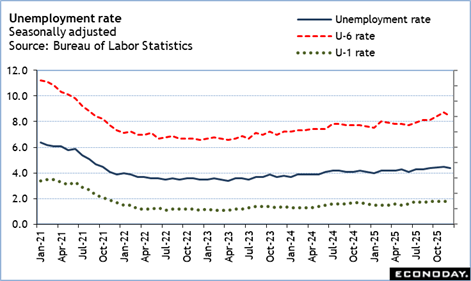
The December unemployment rate is down a tenth to 4.4 percent and below the consensus of 4.6 percent in the Econoday survey. The December reading suggests that the rate has reached a plateau in the middle-4 percent range. Historically, an unemployment rate below 5 percent is considered consistent with a healthy labor market.
Fed policymakers will find little in this report to indicate that the risks to maximum employment are heightened. With GDP showing expansion continues above the longer-run forecast of 1.8 percent, the majority of the FOMC may well conclude that the labor market is in a soft patch, but not deteriorating, and that stimulus is not needed to provide support for this side of the dual mandate.