The two-day federal government shutdown on Monday and Tuesday forced the rescheduling of a few reports. The January employment report expected on Friday is moved to Wednesday, February 11 at 8:30 ET. Without the BLS report, other labor market data came into the fore this week.
The JOLTS report is through December and points to a weaker labor market at year-end. The level of job openings is down 386,000 to 6.542 million in December, but it is the 423,000 decline in private sector job openings that is most telling. Some of the previously open jobs were filled but also there were fewer new jobs on offer as businesses exercised caution about future needs. The level of hiring rose 172,000 to 5.293 million in December. Overall hiring was modest in the private sector and mainly in three industries – private education and health services, leisure and hospitality, and trade, transportation, and utilities. There is less churn in the labor market as voluntary job quits rose a meager 11,000 in December to 3.204 million, while layoffs and discharges are up 61,000 to 1.762 million.
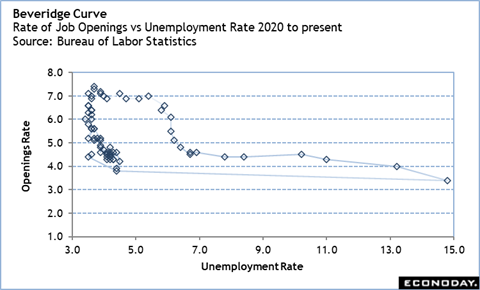
The picture of the labor market can be summed up in the Beveridge Curve which shows that the fall in the rate of job openings versus the national unemployment rate – while still at a place consistent with a health labor market – is starting to break away from the stable conditions seen in the last year or so.
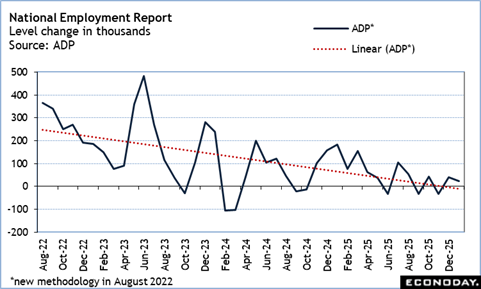
The ADP national employment report for January shows a small gain of 22,000 for private sector payrolls that is losing momentum. The report included annual revisions that brought the monthly average payroll change in 2025 down to up 33,000 compared to up 55,000 before revisions. Under the headline are uneven changes across sectors with decreases very nearly offsetting increases.
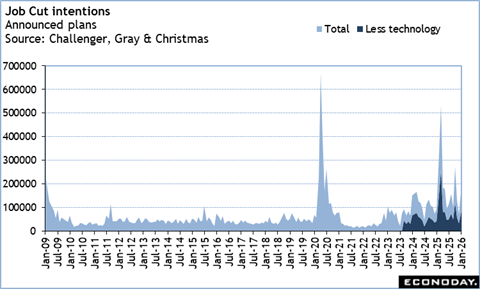
The Challenger job cut intentions report for January points to an uptick in job cuts – reductions in hiring plans, elimination of open positions, and/or outright layoffs. Too much weight should not be placed on a single month’s data, but the January increase is worrisome. Job cuts total 108,135 in January, up 204.2 percent from 35,553 in December. The report notes that this is the highest January level since 241,749 in January 2009 which was just before unemployment began to rise sharply and then stayed elevated in what was called a jobless recovery.