The March 16-18 FOMC meeting ended with a decision to leave rates unchanged. Although the US economy is showing “solid” growth and the labor market relatively stable, inflation remains “somewhat elevated” and risks moving higher.
The tone of the post-meeting statement was broadly positive with an important caveat. The statement said, “Uncertainty about the economic outlook remains elevated. The implications of developments in the Middle East for the U.S. economy are uncertain.”
Much of the question and answer period of Chair Jerome Powell’s Wednesday press briefing centered around the oil shock generated by the attack on Iran that began on February 28. Powell said the FOMC was prepared to react to it as appropriate depending on how long the current episode of higher prices lasted and how much the impact seeps into consumer prices. The full extent of higher prices from tariffs imposed in 2025 has yet to be felt in present upward price pressures and a climb in energy costs will push back a return to the Fed’s 2 percent inflation target.
The 11-1 FOMC vote indicates that a majority of Fed policymakers are more worried about inflation heating up than are immediately concerned about a job market where the unemployment rate remains steadily in a range around the mid-4 percent mark. Powell noted that while job gains are lackluster or absent, the labor supply has shrunk. If the consequent “zero balance” may not be the most desirable to situations in terms of a vibrant labor market, neither does it point to deteriorating conditions.
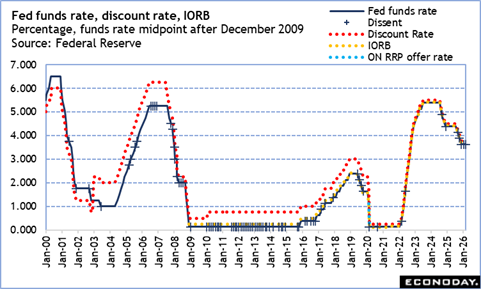
For now, Fed policymakers can say that the current fed funds target range of 3.50 to 3.75 percent is close to the 3.1 percent that that longer-run estimates project as neutral – neither too high or too low to achieve the dual mandate of maximum employment and price stability. If it is mildly restrictive, it is appropriate as upward price pressures work their way through the economy.
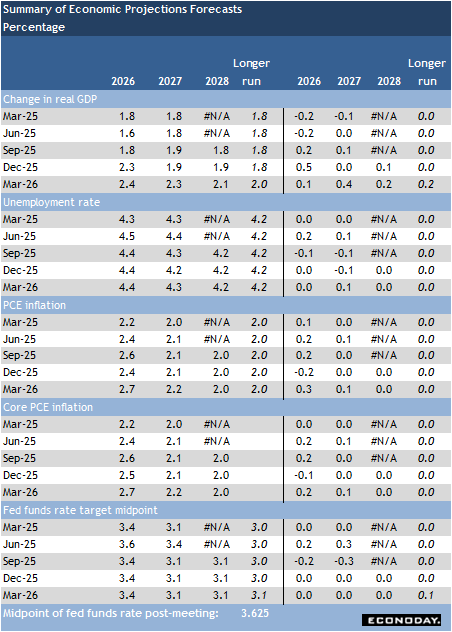
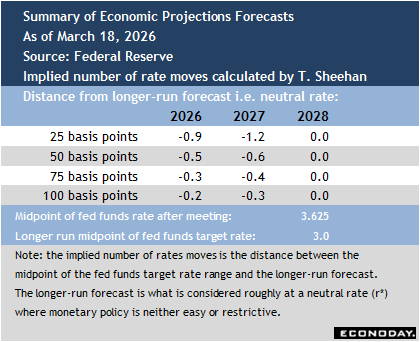
Updates to the quarterly summary of economic projections (SEP) were made against the backdrop of increase uncertainty and therefore should be read with a little extra caution. Overall, the resilient US economy is expected to keep a moderate pace of growth, unemployment remains low, and inflation be a bit higher in the current year. The outlook for the fed funds target rate range is for one small rate cut of 25 basis points this year and another next year. However, this is only a projection and should not be read as a plan or promise.
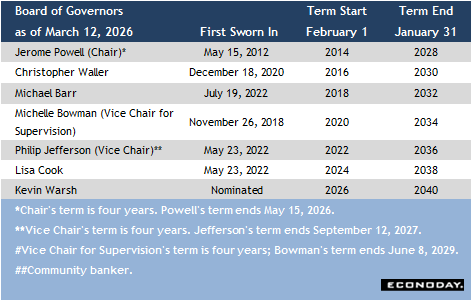
Powell provided an update on his status as Chair of the Federal Reserve. He is awaiting the confirmation of his successor. The Senate Banking Committee has yet to schedule a hearing for Kevin Warsh who President Trump has nominated as governor for the 14-year term ending January 31, 2040 and as chair to a four-year term that will begin if and when he is confirmed and sworn in. If the situation drags on and Warsh is not confirmed by the end of Powell’s term as Chair in mid-May, by law Powell will be Chair Pro Tem until a new Chair is sworn in. Powell has not said if he plans to continue on as a governor after stepping down as Chair. He did say that he is not leaving until the investigation into cost overruns in renovations of Federal Reserve buildings is “well and truly over”. If he does stay until the end of term on January 31, 2028, it will be because he believes it to be in the best interests of the Fed and public service.
The chair’s semiannual monetary policy testimony usually takes place around mid-February to early March. So far this year, the winter testimony has not been scheduled. This is highly unusual. The Chair is required by law to deliver the monetary policy report to Congress. Typically, the Board of Governors prepares the report in late January. If it has done so, it will need to be updated whenever the Senate Banking Committee and House Financial Services Committees set a date.