The news in the week continued to revolve around the war on Iran and the chaotic messaging from the president and Department of Defense. The unknowns facing the domestic economy remain large and unresolved. The uncertainty is having an impact but it remains difficult to parse exactly how profound and long-lasting the impact will be.
A case in point is the March data on the final-demand producer price index (PPI-FD) released on Tuesday.
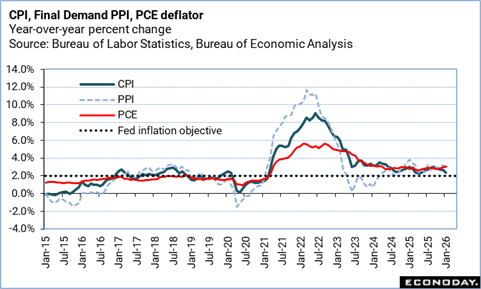
The PPI-FD rose 0.5 percent in March from February and was on trend with up 0.5 percent in February from January, and 0.6 percent in January from December. significantly below the consensus of up 1.2 percent in the Econoday survey of forecasters. The index was up 4.0 percent from a year ago, speeding up from up 3.4 percent in February but well below the consensus of up 4.7 percent in the survey.
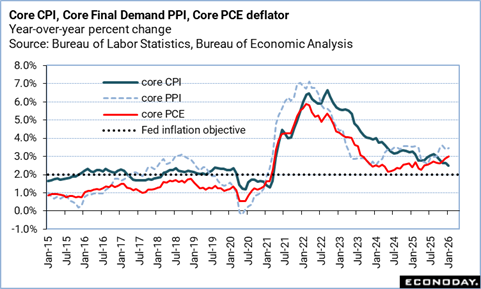
As expected, annual increases were driven by the surge in energy prices. The March PPI excluding food and energy was up 0.2 percent month-over-month and was actually a tick lower than up 0.3 percent in February. Energy prices jumped 8.5 percent month-over-month compared to an increase of up 2.1 percent in February. The index for energy was up 11.2 percent from March 2025 compared to down 0.4 in February.
On the face of it, it looks like producers’ costs did not rise excessively in the context of the war begun on February 28. However, it should be remembered that the PPI takes it reading on energy prices relatively early in the month, usually on the second Tuesday. Consider that the price per gallon of West Texas Intermediate (WTI) crude was $64.00 in the February 10 week, rose 30 percent to $83.71 in the March 10 week, and was up to $114.58 on April 7.
The surge in energy prices may be limited to a handful of months. However, those higher costs will be difficult for producers to absorb and most will be passed on to the consumer level. Some may be in the form of short-term fuel charges, but much will pass through into consumer prices sooner or later.
When Fed policymakers next meet on April 28-29, they will be cautious about the potential for higher energy prices to ripple out into the wider economy.