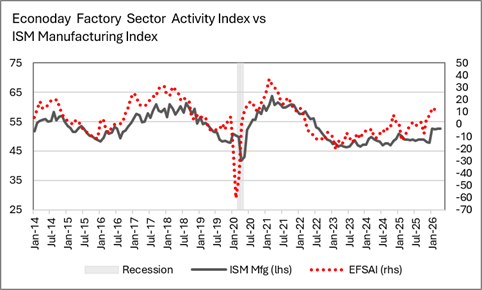
The Econoday factory sector activity index (EFSAI)* for May is 12.5, up from 11.5 in April and versus 13.1 in March. The reading suggests the factory sector continues its modest expansion. Activity appears to be firming amid rising new orders and increasing order backlogs. However, activity is uneven across regions.
A closer look at the individual regional surveys points to conditions that are mixed and uncertain. Where there is some improvement in May it does not seem to be the start of an upward trend. The increases in activity in New York, Richmond, and Dallas still leave the indexes consistent with only modest expansion. The decrease in the Philadelphia index was unusually large and is likely a reset from a jump higher in the prior month. The dip in activity in Dallas and Chicago is well within normal month-to-month fluctuations.
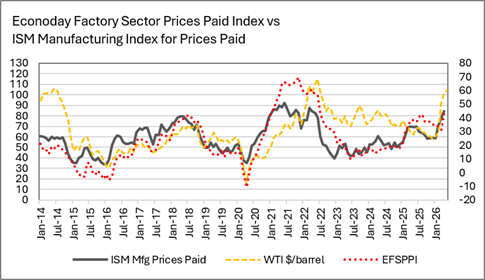
The immediate disruptions from the war on Iran begun on February 28 have settled down, although energy costs remain elevated and are generally pushing the indexes for prices paid higher.
The Econoday factory sector prices paid index (EFSPPI)# rose to 44.4 in May from 43.3 in April and 31.4 in March. This is the highest reading since 56.1 in July 2022. How much of increased costs manufacturers will be forced pass on will depend on how long prices remain at current levels – or higher.
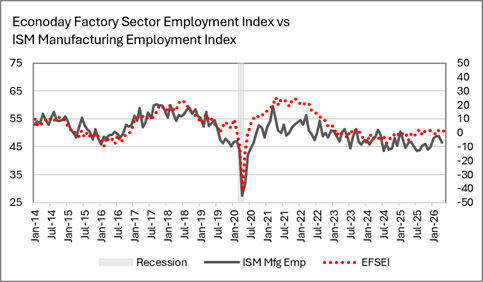
The Econoday factory sector employment index (EFSEI)## points to weakening employment by manufacturers in May. The index is down to 0.9 in May from 1.8 in April and 2.5 in March. In uncertain times, manufacturers are going to hire cautiously, if at all.
The EFSAI has strong correlations** with the major national indexes for activity in the factory sector. It indicates that there may be little month-to-month change in the major indicators.
The S&P manufacturing purchasing managers index had a flash reading of 55.3 for May after 54.5 in April. This is a rise for the second month in a row. The index is at levels not seen since the first half of 2022.
The ISM manufacturing index was unchanged at 52.7 in in April from March and virtually unchanged from 52.4 in February and 52.6 in January. The EFSAI points to a similar reading for May.
The S&P final manufacturing index for May is set for release at 9:45 ET on Monday, June 1.
The ISM manufacturing index for May is set for release at 10:00 ET on Monday, June 1.
*The EFSAI is an average of seasonally adjusted indexes from the Federal Reserve district bank surveys of manufacturing that includes smoothing for month-to-month volatility. The districts correspond with about 48 percent of the US labor force. An index above 0 indicates expanding activity and below 0 indicates contracting activity.
**S&P PMI for manufacturing correlation 0.806, ISM manufacturing 0.885.
#The EFSPPI is an average of unadjusted indexes from the Federal Reserve district bank surveys of manufacturing. The EFSPPI has a correlation of 0.855 with the ISM manufacturing prices paid index.
##The EFSEI is an average of seasonally adjusted indexes from the Federal Reserve district bank surveys of manufacturing. The EFSEI has a correlation of 0.704 with the ISM manufacturing employment index.