Fed Chair Kevin Warsh was at an ECB central banking forum on July 1. In a panel discussion with some of his G-7 counterparts, he reinforced his intentions to reform how the Federal Reserve approaches monetary policy with the institution of five working groups to examine various aspects of Fed practices. He also emphatically embraced ECB President Christine Lagarde’s use of the term “framework guidance” as the successor to “forward guidance”. Warsh indicated that he expects markets and the media to work harder to understand Fed intentions based on the available data used to set policy. It probably isn’t a return to the Greenspan era’s obscure Fedspeak, but communications will contain much less forecast and more about current data trends.
The June employment report was released one day earlier than usual to accommodate the federal holiday on Friday, July 3. Conditions in the US labor market appear to remain in a supply and demand balance but it is one maintained by low hiring and a shrinking workforce.
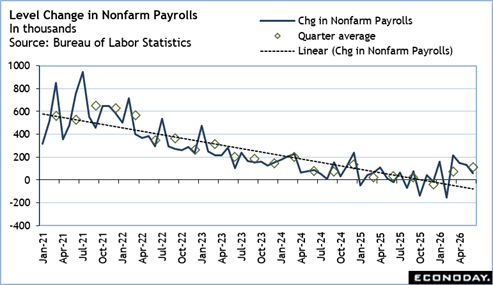
Growth in nonfarm payrolls remains healthy in only a few narrow sectors, primarily in health care and social assistance. Total nonfarm payrolls are up 57,000 in June after downward revisions to up 129,000 in May (previously up 172,000) and up 148,000 in April (previously up 179,000). The average monthly increase for the second quarter 2026 is 111,000 compared to 73,000 in the first quarter. Health care and social assistance is up 47,000 in June, up 46,000 in May, and up 57,000 in April. Health care and social assistance’s monthly average in the second quarter is up 50,000. There is no other consistent source of payroll gains as the economy works it way through the disruptions brought by widespread introduction of artificial intelligence tools and the war on Iran.
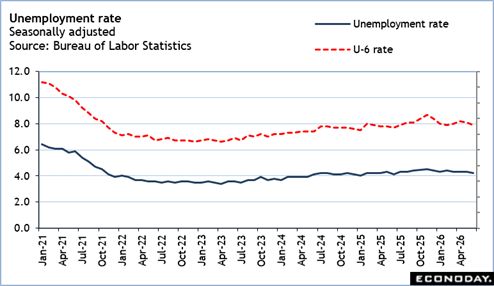
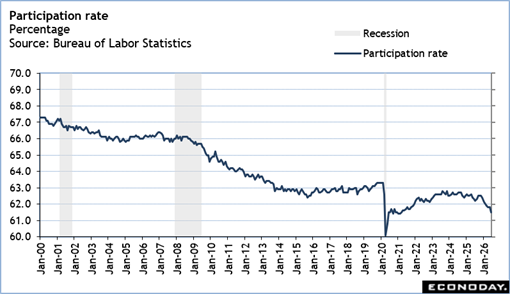
The unemployment rate dips to 4.2 percent in June after three months at 4.3 percent and is the lowest since 4.1 percent in June 2025. The rate is down due to a shrinking labor force which falls 720,000 to 169.358 million in June with decreases of 507,000 in the number of employed and 213,000 in the unemployed. The participation rate falls three-tenths to 61.5 percent, its lowest since 61.5 percent in March 2021. The labor force is again losing workers to retirement, workers finding being employed no longer economically viable, and/or declines in immigrant labor. Labor force participation has not sustainably recovered from the pandemic