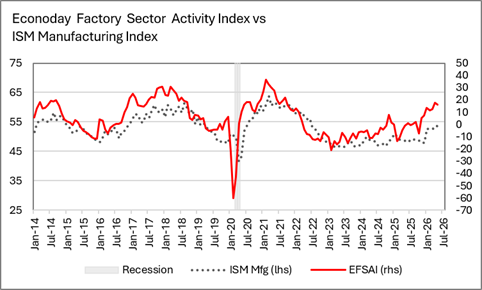
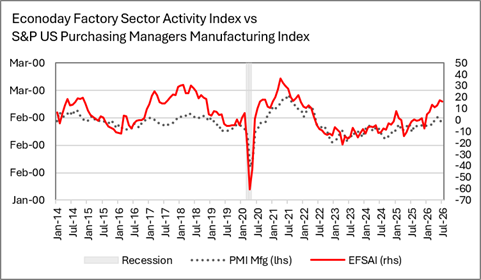
The Econoday factory sector activity index (EFSAI)* for July is 16.2 after rising to 17.4 in June. The reading indicates that manufacturing continued to expand at a modest pace in the past two months. Four of the six index component district bank surveys of manufacturing improved, albeit unevenly (New York, Philadelphia, Richmond, and Dallas). Two surveys reflected somewhat softer conditions for manufacturing activity (Kansas City and Chicago). However, all six surveys point to growth along a spectrum of slight to moderate.
The renewal of military attacks on Iran probably happened too late in the survey period to be reflected in the data. The impact should be clearer in the August numbers, in particular with fuel price retracing recent declines.
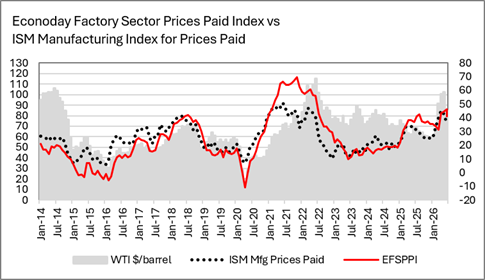
The Econoday factory sector prices paid index (EFSPPI)# slipped to 41.1 in July from 46.3 in June and 44.4 in May. While it is the lowest since 31.4 in March, it remains consistent with upward price pressures that businesses will have difficulty absorbing.
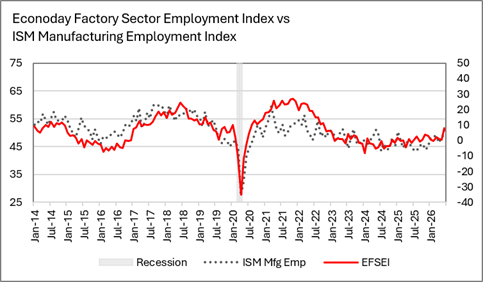
The Econoday factory sector employment index (EFSEI)## points to ongoing hiring by manufacturers. The July index of 6.2 is more moderate than the 8.1 in June but is a solid back-to-back performance for this industrial sector. There could be an increase in manufacturing payrolls in the monthly employment report for July at 8:30 ET on Friday, August 7.
The EFSAI has strong correlations** with the major national indexes for activity in the factory sector. It indicates that July should experience narrow expansion in manufacturing in the national indicators.
The S&P manufacturing purchasing managers index had a flash reading of 53.8 for July after 53.9 in June. This point to essentially unchanged conditions in July from June and that activity may have plateaued against the backdrop of economic uncertainty. The S&P final manufacturing index for July is set for release at 9:45 ET on Monday, August 3
The ISM manufacturing index was unchanged at 53.3 in June from 54.0 May. The EFSAI hints that the ISM measure for July will be a bit lower than in June, but this does not change the overall picture for tempered expansion in manufacturing. The ISM manufacturing index for July is set for release at 10:00 ET on Monday, August 3.
*The EFSAI is an average of seasonally adjusted indexes from the Federal Reserve district bank surveys of manufacturing that includes smoothing for month-to-month volatility. The districts correspond with about 48 percent of the US labor force. An index above 0 indicates expanding activity and below 0 indicates contracting activity.
**S&P PMI for manufacturing correlation 0.805, ISM manufacturing 0.882.
#The EFSPPI is an average of unadjusted indexes from the Federal Reserve district bank surveys of manufacturing. The EFSPPI has a correlation of 0.857 with the ISM manufacturing prices paid index.
##The EFSEI is an average of seasonally adjusted indexes from the Federal Reserve district bank surveys of manufacturing. The EFSEI has a correlation of 0.668 with the ISM manufacturing employment index.