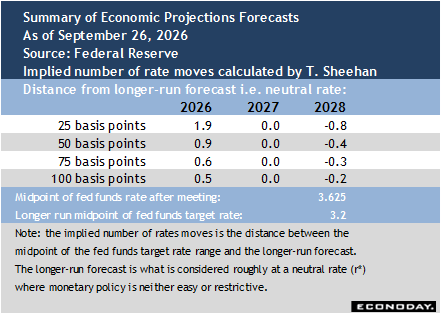
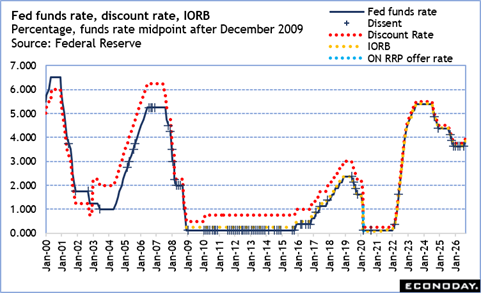
Expectations for a 25 basis point hike in the fed funds target rate range solidified after the August data for the final demand producer price index and consumer price index were released on September 10 and 11, respectively. Those expectations were met when the FOMC announced a rate increase from 3.50 to 3.75 percent to 3.75 to 4.00 percent at 14:00 ET on Wednesday.
This was the first change in rates since the 25 basis point cut in December 2025 and the first rate hike since a 25 basis point increase in July 2023.
The September 16 decision was unanimous. All 12 voters favored a rate hike, although that may not have been true for all 19 FOMC participants. It will probably not be necessary to wait for the minutes of the September 15-16 meeting release at 14:00 ET on Wednesday, October 7 to find out if this was the case. In the meantime, the contents of the summary of economic projections – from which Fed Chair Kevin Warsh abstained – reflect a more hawkish bias toward further rate hikes consistent with the FOMC’s commitment to bringing down inflation through interest rate policy. The current forecast implies another two
In his post-meeting press briefing, Warsh outlined that a rate hike was appropriate to address the risks to price stability. Although the US economy expanded at a “solid” pace and the labor market demand remains tepid but in balance with supply, “geopolitical developments” contributed to keeping inflation elevated. Warsh was resolute in providing no forward guidance for monetary policy. He reiterated that “trends matter” and that policymakers would not react to a single “noisy” data point.
Notably, the press briefing lasted only half an hour rather than the more typical 45 minutes or so in recent years. This suggests that Warsh is keeping his communications more succinct and he will keep tighter control of the narrative.
Meeting the dual mandate meant that the FOMC needed to be attentive to the lengthening risks to the inflation outlook and renewed higher readings in inflation expectations. Those risks are not likely to resolve before the next meeting and could well look worse before the FOMC gathers on October 27-28. The FOMC will have data for the September CPI at 8:30 ET on Wednesday, October 14 and the PPI at 8:30 ET on Thursday, October 15. The committee won’t have the September PCE Deflator which is not set for release until 8:30 ET on Thursday, October 20.