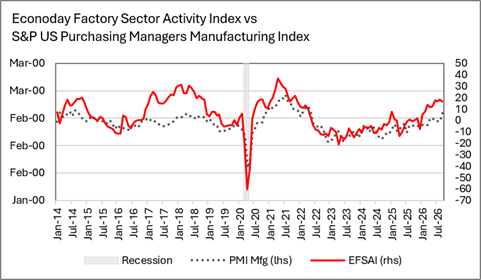
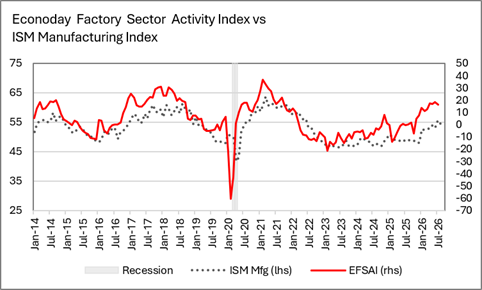
The Econoday factory sector activity index (EFSAI)* for September come in at 16.5 after a rise to 18.4 in August. The index has been moving in a narrow range since June that suggests ongoing modest expansion in business activity.
The index has been trending higher to the current plateau since the start of 2026, albeit unevenly. The dip in the September reading is not in itself significant and is well within normal month-to-month variation. If it declines again in October, it will be more meaningful.
Five of the six component district bank surveys of manufacturing declined in September (New York, Philadelphia, Richmond, Dallas, and Chicago) with only one increase (Kansas City). The downward readings still leave five surveys showing expansion for their respective factory sectors (New York, Philadelphia, Richmond, Dallas, and Kansas City) with only one noticeably trending downward (Chicago).
The reason for the slight softening in conditions in September may reflect choppy new orders across regions, lengthening delivery times along the supply chain, and a great deal of uncertainty around inflation and the economic outlook at a time of political upheaval at home and the continuing conflicts in Ukraine and the Middle East.
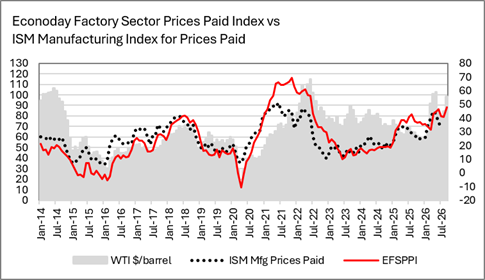
The Econoday factory sector prices paid index (EFSPPI)# jumps to 47.8 in September from 41.0 in August. Much of the blame can be placed on rising energy prices, particularly for those industries reliant on diesel fuel. AAA reports the average price for a gallon of diesel fuel rising steadily and sharply from mid-August and hit a record high of $6.511 in the September 21 week, although it has eased at $6.453 in the week ending September 28. Nonetheless, the surveys reflect manufacturers increased costs in operations and some services like transportation of goods. Even if prices level out or decline somewhat, the bottom line for costs will be higher.
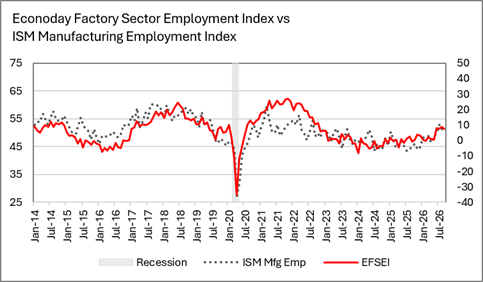
The Econoday factory sector employment index (EFSEI)## points to ongoing hiring by manufacturers, if at a slightly slower pace than the prior month. The September index of 7.6 is below 8.6 in August. Like the overall index, the employment index has been fairly steady for the past four months. This suggest another month in which manufacturing payrolls will post a modest gain when the September employment report is released at 8:30 ET on Friday, October 2.
The EFSAI has strong correlations** with the major national indexes for activity in the factory sector. It indicates that September should be another month of moderate expansion in manufacturing in the national indicators.
The S&P manufacturing purchasing managers index had a flash reading of 57.0 for September after 53.9 in August. This points to firming conditions in September from August that hints at sufficient new orders to boost activity. The S&P final manufacturing index for September is set for release at 9:45 ET on Thursday, October 1. The Econoday consensus forecast is 53.2 for September.
The ISM manufacturing index was down to 54.6 in August from 55.6 July. The EFSAI points to an ISM measure for September will be a bit lower than in August, but this does not change the overall picture for temperate expansion in manufacturing. The ISM manufacturing index for September is set for release at 10:00 ET on Thursday, October 1.
______________
*The EFSAI is an average of seasonally adjusted indexes from the Federal Reserve district bank surveys of manufacturing that includes smoothing for month-to-month volatility. The districts correspond with about 48 percent of the US labor force. An index above 0 indicates expanding activity and below 0 indicates contracting activity.
**S&P PMI for manufacturing correlation 0.803, ISM manufacturing 0.881.
#The EFSPPI is an average of unadjusted indexes from the Federal Reserve district bank surveys of manufacturing. The EFSPPI has a correlation of 0.858 with the ISM manufacturing prices paid index.
##The EFSEI is an average of seasonally adjusted indexes from the Federal Reserve district bank surveys of manufacturing. The EFSEI has a correlation of 0.668 with the ISM manufacturing employment index.