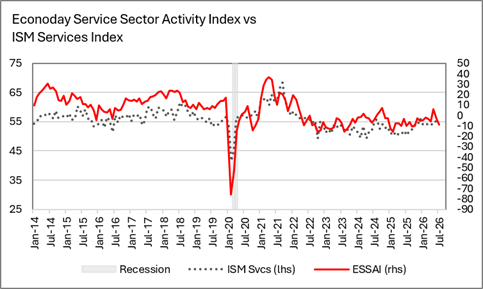
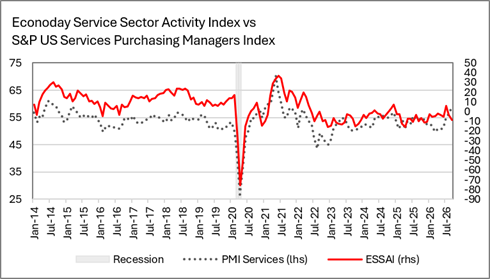
The Econoday service sector activity index (ESSAI)* for September falls to minus 8.7 from minus 3.2 in August and is down for the second consecutive month. The ESSAI has only seen one positive reading so far in 2026 back in July when there was briefly an expectation that the war on Iran would end.
In September, four of the six component Fed district bank surveys for the service sector decreased in September (New York, Philadelphia, Dallas, and Chicago) and all were sharply lower. The rise in two (Richmond and Kansas) only brought their respective indexes up to the neutral mark. No regional survey had a positive reading in September. The service sector continues to struggle with low business and consumer confidence, worrisome levels of inflation that derived largely from energy costs, and an uncertain economic outlook.
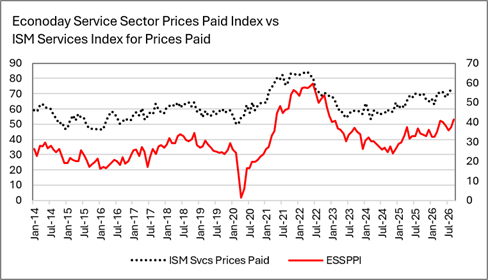
Input prices in September were on the rise again. The Econoday service sector prices paid index (ESSPPI)# rose to 41.4 in September from 37.3 in August. It is the highest since 42.9 in December 2022. The shock to energy prices after the war on Iran started eased over the summer but renewed hostilities and spreading conflict is driving prices up again. Businesses where motor fuels factor into pricing are having the most problems with higher input costs. In particular, the record highs for a gallon of diesel fuel is hurting the transportation sector and leading to pass-through to commercial and household customers.
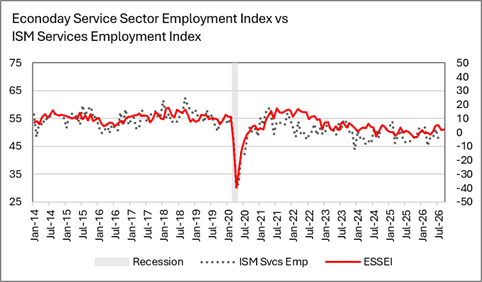
The Econoday service sector employment index (ESSEI)## is essentially unchanged at 2.0 in September from 1.9 in August. Services are reluctant to hire any but necessary workers and/or are restrained in hiring by a limited pool of qualified applicants.
The ESSAI has good correlations** with the major national indexes for activity in the service sector.
The S&P services purchasing managers index had a flash reading of 58.7 for September, up from the final 56.5 in August. The index generally sees only minor revisions from the flash to the final report. The S&P index is taken later than the regional surveys and is likely the more accurate perception of current conditions for the service sector. The final S&P services purchasing managers index for September is set for release at 9:45 ET on Monday, October 5.
The ISM services index was up to 55.4 in August from 54.1 in July. Conditions in the service sector have been more-or-less steady since 54.0 in March, but activity remains more restrained since the start of the war on Iran on February 28. The conflict remains unresolved. Even if the energy-related inflationary pressures fall soon, service business will probably not be able to lower their prices as they make up for previous shortfalls in profits. The ISM services index for September is set for release at 10:00 ET on Monday, October 5.
_____
*The ESSAI is an average of seasonally adjusted indexes from the Federal Reserve district bank surveys of the non-manufacturing sector. The districts correspond with about 48 percent of the US labor force. An index above 0 indicates expanding activity and below 0 indicates contracting activity.
**S&P PMI for services index correlation 0.746, ISM services index 0.747.
#The ESSPI is an average of unadjusted indexes from the Federal Reserve district bank surveys of the non-manufacturing sector. The ESSPI has a correlation of 0.841 with the ISM services prices paid index.
##The ESSEI is an average of seasonally adjusted employment indexes from the Federal Reserve district bank surveys of the non-manufacturing sector. The index has a correlation of 0.756 with the ISM services index.