Although the FOMC tends to dismiss survey measures of consumer confidence as not necessarily reflecting economic realities, the political impacts of pessimistic consumer attitudes may have implications for the US economy, at least depending on the outcomes of the midterm elections.
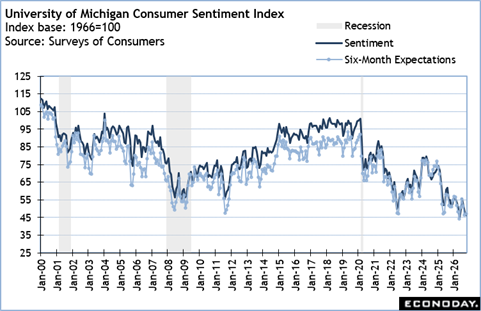
The University of Michigan consumer sentiment index is hovering around record lows that reflect disaffection of voters for politicians of all stripes and the profound household concerns about inflation, particularly for nondiscretionary goods and services.
The preliminary reading for October of 46.3 is the lowest since 44.8 in May when the index hit a series bottom. Consumers are not feeling prosperous or secure either currently or in the near future. The present conditions index is a bare 44.7, a record low for the series. The expectations index is up a point to 47.3 in October from 46.3 in September but remains consistent with signaling a recession. An actual recession may not be in the offing, but consumers are likely to behave like they think one will happen. Household spending may not have been declining in the aggregate but spending power is diminished.
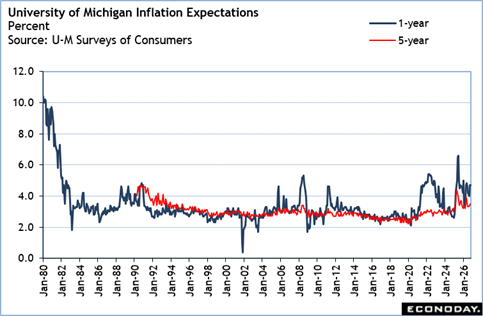
The FOMC will be carefully watching the direction of the inflation data set for release in the coming week as it affects price stability and any indications that inflation expectations are inconsistent with the Fed’s credibility as an inflation fighter. The survey of consumers’ measures of inflation expectations point to anticipation of higher prices. The 1-year inflation expectations readings – which tends to be affected by things like gasoline prices – is up to 4.7 percent, the highest since 4.8 percent in May. Fed policymakers are more focused on the medium term, but there the 5-year expectation is for up 3.5 percent inflation, up from 3.4 percent in September and the highest since 3.9 percent in May.