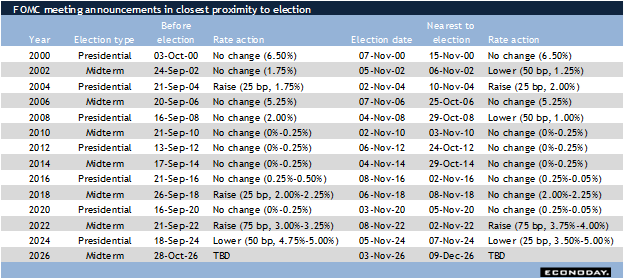
Fed policymakers do their best to set monetary policy apolitically but there is no escape from the timing of the upcoming FOMC meeting on Tuesday-Wednesday, October 27-28, less than a week before the midterm election on Tuesday, November 3. The eight-times-a-year calendar of FOMC meetings means there is typically one scheduled in late October or early November.
In most years with a federal election, there is a gap of about six weeks between the September meeting and the next one. If the normal timing of the first day of the meeting coincides with election day, the FOMC delays the meeting by one day to Wednesday-Thursday. Infrequently the meeting falls in the prior week in an election year.
Particularly in election years, the FOMC can be criticized as trying to sway the outcome based on its rate decision. It hardly matters what the decision is when any decision can be read as supportive of an opposing party. However, the facts are that the FOMC rarely adjusts rates at the meeting before the election. In those years that it did, the decisions reflect the economic realities of the time. It is notable that in 2022 rates were being raise to combat inflation and in 2024 they were being lowered when inflation pressures were ebbing.
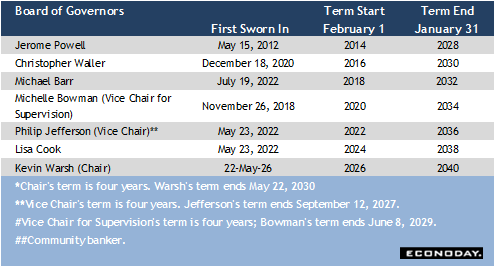
In 2026, the meeting is unusually close to the election and comes at a time when the FOMC is vulnerable to having its independence attacked with four of the seven on the Board of Governors being Trump appointees and one of those now the chair (President Trump could have the opportunity to appoint at least one more governor if he manages to oust Lisa Cook – unlikely but possible. Then there’s the possibility of another Trump appointee when Jerome Powell’s term ends on January 31, 2028).
The FOMC raised the fed funds target rate ranged by 25 basis points to 3.75 to 4.00 percent at the September 15-16 meeting to address renewed inflationary pressures brought on by the start of the war on Iran on February 28. The FOMC is weighing the initial impacts of higher prices for energy and the pass through to goods and services. Fed Chair Kevin Warsh has repeatedly said that the FOMC can and will bring inflation back down to the 2 percent inflation target.
Explicit in the deliberations at the October 27-28 meeting will be just how much threat the recent inflation data represents to the price stability side of the dual mandate and the urgency with which it needs to be addressed. Implicit in the discussions will be cost to the Fed’s credibility in moving too slowly to combat inflation versus taking no action to avoid looking like it is boosting Trump’s opposition with a rate hike.