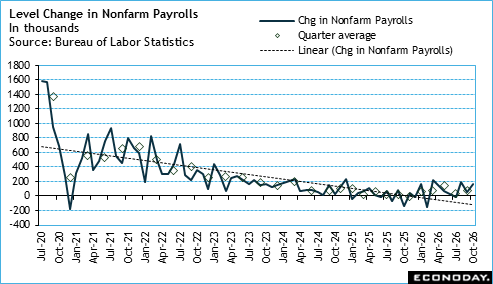
The October employment report presented an upside surprise with a gain of 165,000 in nonfarm payrolls for the month on top of a net upward revision of 84,000 in the prior two months. The October increase starts the fourth quarter 2026 off with a strong reading compared to the monthly average of up 79,000 in the third quarter, up 28,000 in the second quarter, and up 142,000 in the first quarter. It is possible that hiring could remain stronger in the remaining two months of the year. However, the underlying pace is probably closer to the prior quarters.
Hiring continues in a few narrow sectors. Private payrolls are up 159,000 in October with the now reliable health care and social assistance sector up 55,100, just over a third of all increases. It was something of a surprise to see an increase of 70,000 in professional and business services which reflects hiring of consultants, administrators, and temporary help. Some of this could be related to last-minute hiring as election campaigns amped up in highly contest races. If so, many of these workers will be laid off in the counts in November or December, depending on if they were paid in the November survey period.
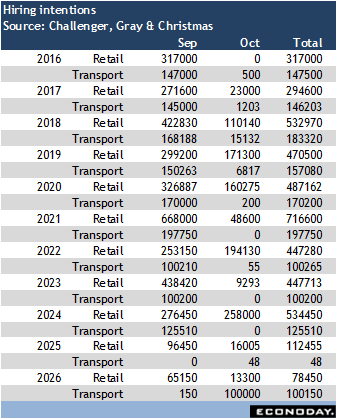
Also notable among private payrolls is an increase of 17,400 in couriers and messengers which probably is the start of the ramping up before the winter holiday shopping period. In fact, the Challenger hiring intentions for October showed plans to add 100,000 in transportation in advance of the holidays, quite similar to the trend in recent years with the shift to online shopping. Conversely, the contraction in the retail sector for brick-and-mortar stores and low consumer confidence – plus a lack of labor – has restrained hiring in October at a time when stores normally try to beef up staffing. Retail payrolls are up only 6,000 this October and the Challenger hiring intentions were a relatively small 65,150 in September and dropped to 13,300 in October.
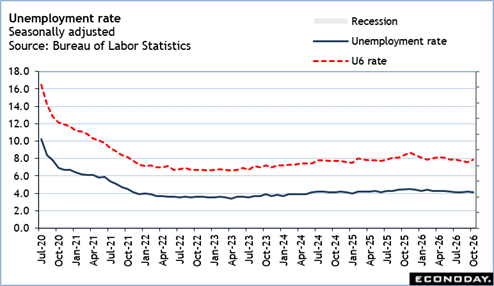
The unemployment rate dips one-tenth to 4.1 percent in in October with a rise in the number of people employed and a slight decline in the number of people unemployed. The size of the labor force increased 421,000. Hiring may have improved for people with the right skills and experience. On the other hand, the U-6 unemployment rate – the broadest measure of unemployment – is up three-tenths to 7.9 percent and suggests that those workers who want a full-time job or are otherwise marginally attached to the labor market are seeing less employment.
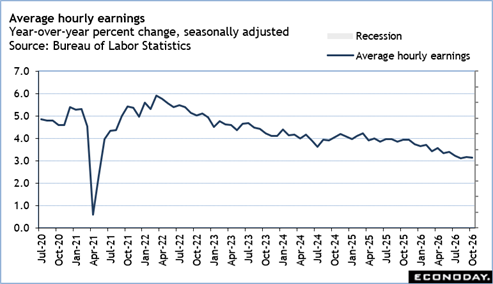
Average hourly earnings are up 0.4 percent in October from September and rise 3.1 percent from a year ago. Recent months have shown that the annual pace of increases is flattening out. While skilled workers in some sectors continue to received higher wages as business fight to attract and retain them, most other workers are seeing only modest increases.