Three reports for April that shape the inflation picture were released in the May 15 week leading to three conclusions.
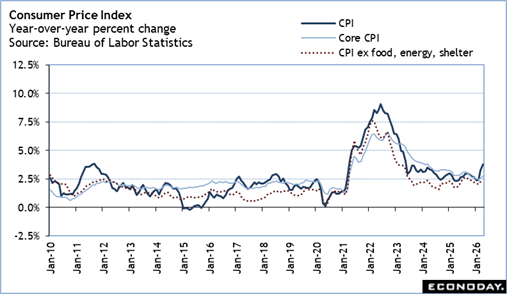
First, the consumer price index (CPI) for April showed the spike in energy prices in March and continued elevated and unstable prices into April is already having an impact that is going to be reflected in household spending. In particular, the rise in fuel prices is being passed on to consumers not only in gasoline purchases, but in higher transportation costs for essentials like food and shelter. The all-items CPI is up 0.6 percent in April from March after up 0.9 percent in March from February. However, even if the month-over-month pace of upward price pressures is easing, the annual rate is picking up steam. The CPI for all items is up 3.8 percent compared to April 2025, up five-tenths from the prior reading. The April core CPI is up 2.8 percent, two-tenths higher than the March reading. The CPI excluding shelter is up 4.1 percent compared to a year ago after 3.4% in March.
The CPI for food is up 3.1 percent year-over-year in April, four-tenths higher than the prior report. Energy prices jump 17.9 percent compared to April 2025 with gasoline prices up 28.4 percent. This is a significant acceleration from energy prices rising 12.5 percent in March and gasoline prices up 18.9 percent. Shelter costs are up 3.3 percent year-over-year in April after 3.0 percent in the prior three months. Any deterioration in housing affordability is unwelcome. These three components comprise 56 percent of the relative importance in the CPI. While consumer may end up spending less in terms of total dollars, less will be directed toward nondiscretionary spending which will hamper growth.
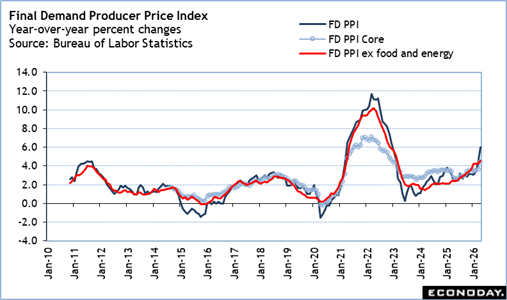
Second, the final-demand producer price index (PPI) surprised to the upside in April with a 1.4 percent month-over-month increase and rise of 6.0 percent year-over-year. Some of the higher-than-expected increase can be attributed to the timing of the PPI read on energy costs. This takes place early in the second week of the month. In early April, the price of a barrel of WTI crude was topping $100. It declined in subsequent weeks, although the price is again well over $100 in early May. The price of a gallon of regular gasoline climbed over the $4 mark in early April and stayed there for the rest of the month. It is on the rise again in early May. Producers are not seeing significant relief in elevated energy costs. Future indexes may rise more slowly or even not at all, but the cost of inputs from goods and services shows no immediate sign of moving down.
The April PPI rose 1.4 percent in April from March and escalated from up 9.7 in March from February. The PPI rose 6.0 percent compared to April 2025, a hike from up 4.3 percent year-over-year in March. The core PPI – excluding food, energy, and trade services – is up 0.6 percent in April after up 0.2 percent in March. Compared to April 2025, the core PPI is up 4.4 percent, faster than the up 3.7 percent in March.
The PPI for foods is up 0.2 percent in April from the prior month and 2.2 percent higher than a year earlier. The annual increase is up from a rise of 1.2 percent in the prior month. The PPI for energy rose 7.8 percent in April after climbing 10.1 percent in March. The year-over-year increase in April was 22.7 percent after 13.0 percent in March. The PPI for trade services is up 2.7 percent month-over-month in April after up 0.2 percent in March. The annual increase for trade services is up 5.5 percent in April after 3.9 percent in March. The elevated cost of getting goods and services to customers will not be easily absorbed and will have to be recouped in the form of fees and/or higher prices.
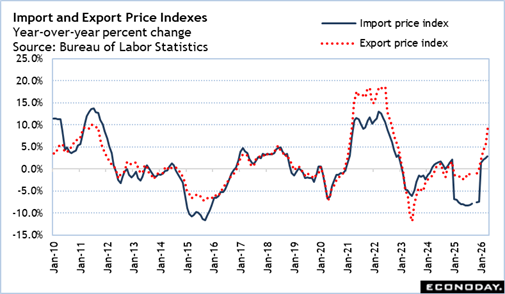
Third, the import price index for all commodities was up 1.9 percent in April from March and rose 4.2 percent from a year ago. The import prices index excluding fuels is up 0.7 percent from the prior month and up 3.3 percent from April 2025. Oil imports are priced in US dollars. A slight firming in the US dollar against other currencies does not change that oil prices were significantly elevated. However, other imported goods were more expensive as well. It is notable that industrial supplies and materials – which have a relative importance of 22.499 in the import price index – increased 6.7 percent month-over-month in April and are 13.1 percent higher than a year ago. The cost of investing in business infrastructure could cool some of the growth in that sector of the US economy.
The export price index rise of 3.3 percent in April from March and 8.8 percent year-over-year increase is also an energy store. All exports excluding fuels is up 0.8 percent in April from the prior month and up 5.4 percent compared to April 2025.
Federal Reserve policymakers are going to find ample evidence that the risks to price stability outweigh those to maximum employment. The possibility of a rate cut in 2026 is retreating. The depth and length of the oil shock from the war on Iran is a big unknown that will ensure that a majority of the FOMC remain cautious about any changed to interest rates.
As a footnote, Kevin Warsh has been confirmed by the Senate to fill the term of governor that began February 1, 2026 and runs through January 31, 2040 and to become the next Fed Chair. He will shortly be sworn in and take his place as the 17th Chair of the Fed.