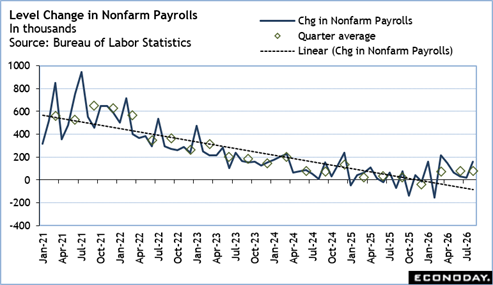
Although the August employment report presents an upside surprise with an increase of 162,000 and a net upward revision to the prior two months of 55,000, this is not a sign of strengthening labor demand. This only brings the month’s average increase in payrolls up to 80,000 for the first two months of the third quarter, virtually indistinguishable from up 81,000 in the second quarter monthly average, and not materially higher than up 73,000 in the first quarter.
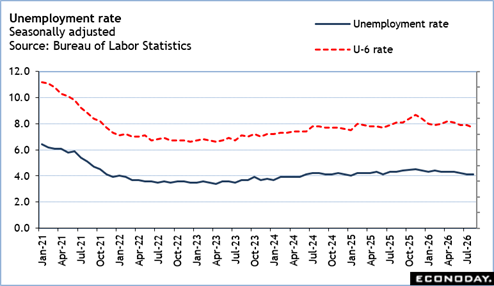
The August unemployment rate is unchanged at 4.1 percent from July. The labor force expanded 683,000 to 169.777 million in August with increases of 569,000 and 115,000 in the number of employed and unemployed, respectively. At least in part, the employment story is one associated with the start of a new school year.
Fed policymakers will read between the lines on this data and probably conclude that the balance between tepid labor demand and a shrunken labor force continues, and that the maximum employment side of the dual mandate is under less risk than price stability. The FOMC next meets on September 15-16, so this is the last major piece of data about employment that they will have to take into consideration in setting monetary policy.
Private sector payrolls are up 127,000 in August, although gains are uneven. Industries that have been steadily hiring continue to do so. In particular, healthcare and social assistance is up 28,000 in August after rising 13,000 in July and 39,000 in June. Others that are more affected by seasonal activity are inconsistent such as leisure and hospitality which gains 62,000 in August after declining 21,000 in July and 54,000 in June.
Government payrolls are up 35,000 in August but this is entirely due to increases at the local level that are offset by declines in state and federal payrolls. Local government education added 41,900 jobs in August and non-education added 8,200 jobs. Some of this is probably due to the relatively late timing of Labor Day on September 7, 2026 which shifted the start of some school years from July to August.
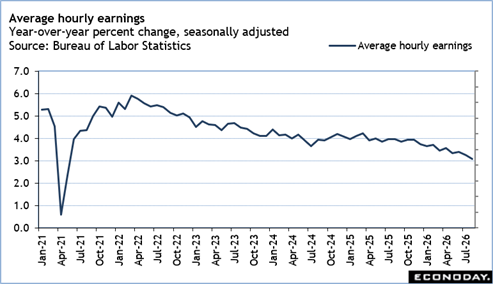
Average hourly earnings are up 3.1 percent compared to August 2025 to the lowest annual increase since up 2.3 percent in May 2021 and more in line with pre-Covid pandemic gains.