On the surface, the May numbers for the employment situation suggest that the labor market is well able to absorb new entrants and provide jobs for the unemployed as well as opportunities for those looking for switch jobs. The balance between labor supply and demand seems to have tipped slightly with firmer hiring. However, optimism should be tempered with a closer look.
The April payroll increase of 172,000 is on top of a hefty upward revision of 93,000 to the prior two months. Few businesses were hiring outside of a handful of industries. The gains of 120,000 in private sector payrolls were mainly in construction (17,000), health care and social assistance (35,200), and leisure and hospitality (70,000). Government added 52,000 jobs which was almost entirely at the local level (55,000) with a meager increase at the federal level (1,000) and decrease in state hiring (minus 4,000).
The health care sector has been one of the few bright spots in hiring for some months. Construction job gains were mostly for specialty trades (14,000) which suggests that only skilled workers are in demand. Leisure and hospitality hiring probably reflects an early start to the summer vacation and travel period with the timing of the Memorial Day observance. Local government hiring may also be for seasonal workers brought on for the summer months. When the June employment report is issued on Thursday, July 2 at 8:30 ET (one day early to accommodate the July 4 holiday7) it will likely be softer in these sectors.
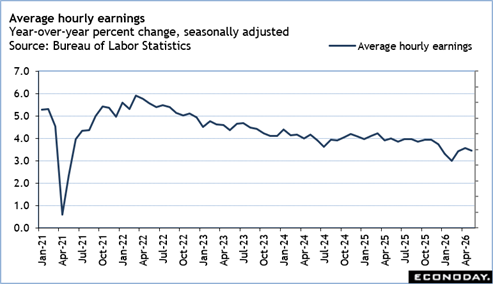
If hiring is stronger, the pace of wage increases is moderate. Average hourly earnings increased a mild 0.3 percent in May from April. Compared to a year ago, average hourly earnings are up 3.4 percent. The annual increase is modest and in line with recent months.
The unemployment rate is unchanged at 4.3 percent in May while the U-6 rate – the broadest measure of unemployment – is down a tenth to 8.1 percent. Overall, the size of the labor force is essentially unchanged at up 83,000 to 170.1 million ion May with the number of employed up 149,000 and unemployed down 66,000.
The labor force participation rate is flat at 61.8 percent in May and holding at levels consistent with limited labor supply.
When Fed policymakers meet on June 16-17, they will be balancing the risks to the outlook for maximum employment and price stability. At the moment, maximum employment does not appear to be in need of support with lower interest rates. On the other hand, data on inflation and inflation expectations is counseling caution about lowering rates.