The reports for consumer price index (CPI) and the final-demand producer price index (PPI-FD) in July show a welcome continuation in moderation in upward price pressures on an annual basis that began in June. Nonetheless, Federal Reserve policymakers are going to remain cautious on the outlook for restoring price stability in line with the Fed’s 2 percent inflation target.
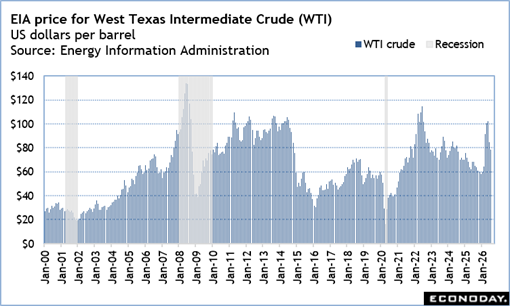
The main factor affecting prices at the moment is energy costs. As the war on Iran drags on with dubious prospects of a sustainable resolution in the near term, the threat of volatility in energy costs is not going away. The FOMC will need greater assurance that oil prices are less likely to spike again even if prices do not fall appreciably from current levels.
The FOMC does not meet again until September 15-16. The next CPI is set for release at 8:45 ET on Friday, September 11 and the PPI at is Thursday, September 10:00 at 8:45 ET. Further improvement in price pressures in these reports could lessen the tightening bias of some participants, although it would be unlikely to be enough to keep rates on hold for the time being. A flat or higher reading could raise the possibility of a rate hike as a mid-cycle adjustment to ensure inflation is tamed.
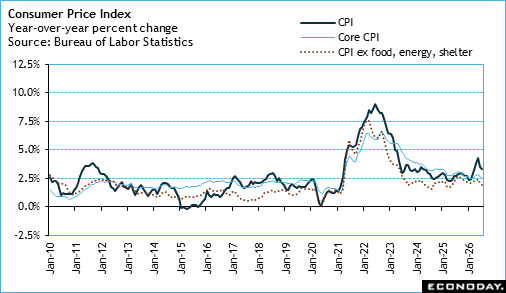
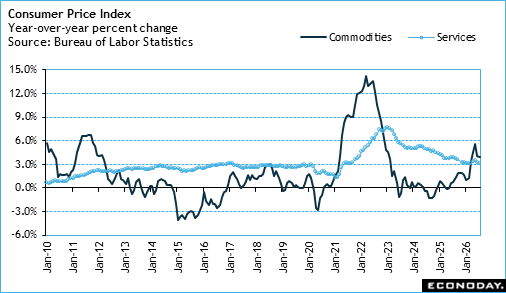
In the meantime, the July CPI data points to a leveling out in at least some prices. The all-items CPI is up 3.4 percent in July from a year earlier compared to up 3.5 percent in June. The core CPI is up 2.5 percent year-over-year in July compared to up 2.6 percent in June. Falling prices for commodities – primarily oil – puts the CPI for commodities at up 3.9 percent from July 2025 after up 4.1 percent in June. The CPI for services is up 3.1 percent from July a year ago after up 3.2 percent in the prior report. By and large the pass through from the producer levels seems to have eased quickly. However, that does not mean the prices to consumers have come down appreciably, especially in areas important for household nondiscretionary spending like food, fuel, and shelter.
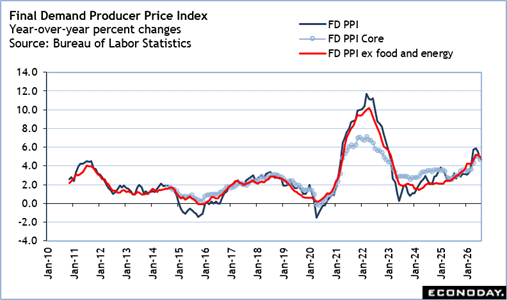
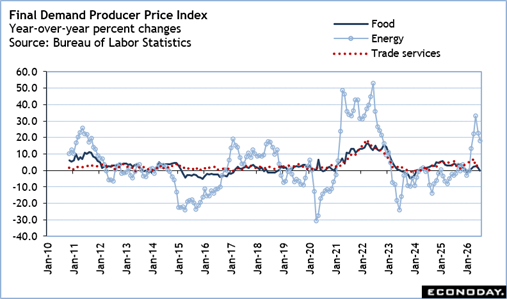
Producer prices in July also suggest upward price pressures are flattening out. The final demand PPI was up 4.7 percent in July from a year earlier, a share easing from up 5.5 percent in June. The core PPI – excluding food, energy, and trade services – was up 4.7 percent in July from the year ago month compared to up 5.0 percent in June. Final demand goods prices were up 6.5 percent from July 2025, with food prices down 0.1 percent, energy prices up 18.2 percent, and trade services up 2.4 percent.
The caveat for the June energy component in the PPI is that the survey takes its reading early in the month. In the second week of July, the EIA average price for a barrel of WTI crude was $70.26 compared to $92.16 in the same week in June. By the first week in August, that price was up to $78.94.