The week ending October 16 saw the release of the final monthly data that could shift the balance of deliberations at the upcoming October 27-28 FOMC meeting. The story remains one of energy prices generally and motor fuels in particular. Fed policymakers are going to carefully parse the data about inflationary pressures in light of the soft employment report for September.
In balancing the dual mandate of price stability and maximum employment, has the labor market decelerated that another rate hike to address inflation going to further slow it from its current sluggish state? Or has inflation heated up enough that inflation expectations are getting uncomfortably high again and a rate hike is needed to cool things down? At the moment, the FOMC is likely to remain cautious and hold the fed funds rate steady. Although not an explicitly political decision, the uncertainty in front of the US midterm elections and geopolitical situation means that the FOMC will not want to be seen as trying to influence events without a clear-cut economic reason.
It was a one-two punch with the September reports of the consumer price index (CPI) on Wednesday and final-demand producer price index (PPI) on Thursday. The headline for prices came in close to or at market expectations. However, if there were no real surprises, the acceleration in costs for major consumer purchases how that the current forces driving prices have yet to ease.
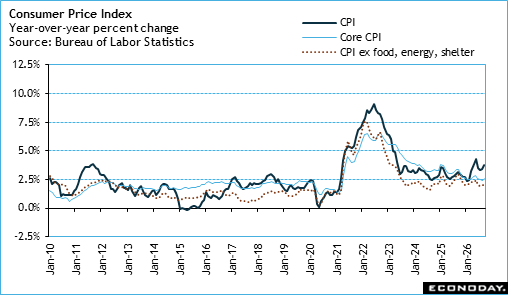
The all-items CPI was up 3.7 percent year-over-year in September, up three-tenths from the prior month’s report and back to a pace seen at the first shocks following the onset of the war on Iran. Much of the overall gain was due to three components which make up over half of the CPI basket of goods and services.
The CPI for food and beverages rose 2.4 percent year-over-year in October, moderating from recent months but still rising fast enough to inspire cautious buying and item substitutions. Energy prices jumped 20.4 percent from September 2025 with gasoline prices up a whopping 34.2 percent compared to a year ago. Consumers can only try to reduce driving to keep costs down. Shelter prices rose 3.2 percent from September, a bit higher after easing off in the prior three months.
The CPI excluding food, energy, and shelter is up 2.0% year-over-year in September, the same as in August. This indicates that while there may not be widespread gains for prices of consumer goods and services, the ones that are the heart of household budgets are heading higher. If the remaining share of goods and services are not experiencing accelerating inflation, it does not change that consumers’ wallets are seeing reduced spending power. The current sources of inflation may be of limited duration but as long as the wars in the Middle East and Ukraine linger, there will be a great deal of uncertainty about future prices. There is little immediate chance that current prices will decline meaningfully for most consumers.
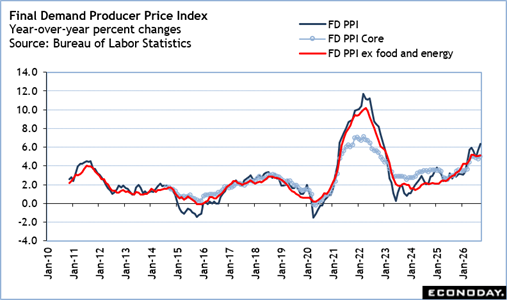
The September PPI gave a strong signal that pass through of costs from the producer level should be anticipated in the coming months. The September total PPI was up 6.3 percent compared to a year ago, a seven-tenths jump from the prior month. The core PPI – excluding food, energy, and trade services – was a more modest two-tenths higher at up 5.0 percent year-over-year. The PPI excluding food and energy was up 5.1 percent in September, the same as in August.
The PPI for food was flat in September compared to a year earlier, while energy costs soared 35.4 percent. Trade services are up 4.7 percent from September 2025. These sorts of energy price increases are hard for producers to absorb and will get passed on to customers as much as possible. These will also linger in the form of higher costs of trade service which involve transportation.