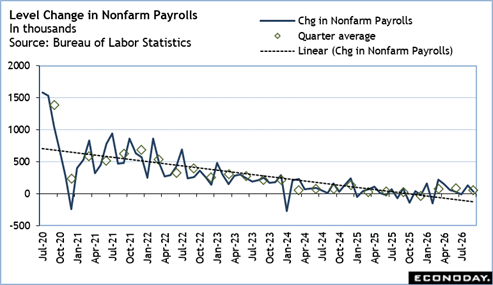
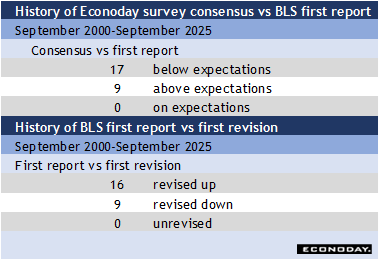
The October 2 week ended with a big disappointment in the form of the monthly employment data for September. Nonfarm payrolls added a meager 29,000 in September while the data for the prior two months had a net downward revision of 60,000. The forecaster consensus was nonfarm payrolls to increase 90,000.
The average monthly change in nonfarm payrolls in the third quarter is up 51,000 compared to up 81,000 in the second quarter and 73,000 in the first quarter. Nonetheless, the softer readings suggest there is less momentum for hiring at present. Businesses may be reluctant to take on new workers until there is less uncertainty. The looming midterm elections and lengthening conflict with Iran are clouding the outlook.
It should be noted that the September report does have a strong tendency to come in below expectations and subsequently be revised higher. However, even a solid upward revision would not change the fundamentals that hiring is generally soft except in a few narrow sectors.
Private payrolls are up 46,000 in September. Private sector job gains were mostly from an increase of 23,000 in healthcare and social assistance, 11,000 in construction, and 10,000 in leisure and hospitality – the three most consistent sources of new jobs in recent months. The latter two need skilled workers who are in short supply, and the former is uneven as seasonal demands are confronted with an uncertain outlook for consumer discretionary spending. Government jobs are down 17,000 at the end of the fiscal year as all levels of government adjust spending in advance new budgets.
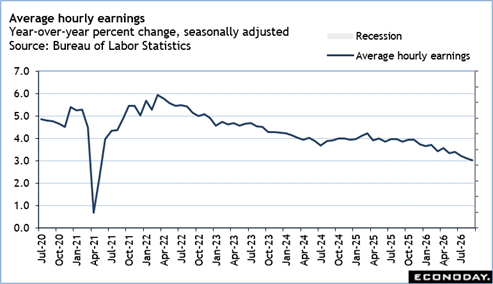
Upward pressure on wages continues to abate and lag behind the pace of inflation. The year-over-year rise in average hourly earnings is 3.0 percent in September, the slowest since up 2.3 percent in May 2021 just before the pace of increases heated up along with hiring.
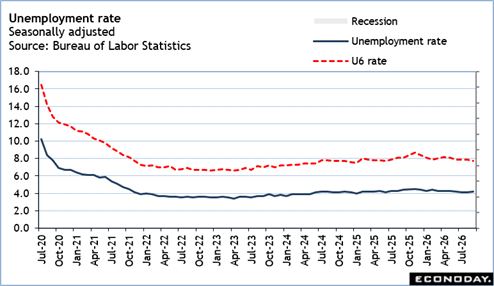
The unemployment rate is up one-tenth to 4.2 percent in September, but the unrounded rate is 4.1753 percent compared to 4.143 percent in August. This is essentially unchanged from the prior month. The slightly higher unemployment rate reflects a 485,000 increase in the labor force to 170.262 million in September with the number of employed up 406,000 and unemployment up 78,000. A larger labor force pushed the participation rate up two-tenths to 61.8 percent in September. The level remains below the pre-pandemic readings as the fundamentals of the labor force have changed with an aging workforce and loss of immigrant workers.
Fed policymakers will see the September report as a single data point and look at the trend which is one of tepid hiring balanced against a limited labor supply. They are likely to interpret the numbers as the maximum employment that can be sustained in the current economy where moderate growth is not stimulating demand for new employment.