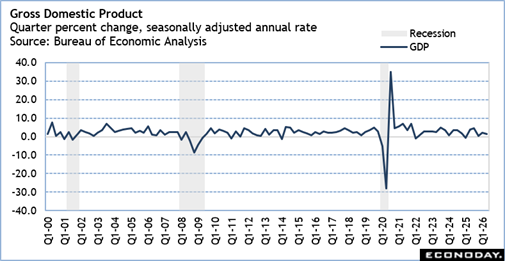
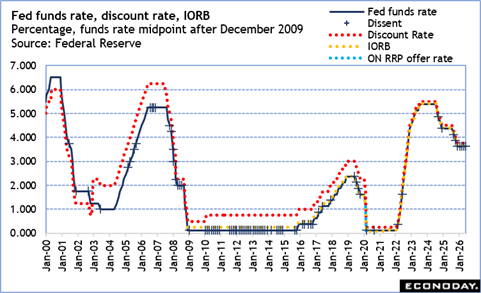
In the week ending July 31, the FOMC kept the federal funds target rate range unchanged at 3.50 to 3.75 percent where it has been since December 2025, and the advance estimate for second quarter 2026 GDP came in below expectations at up 1.5 percent.
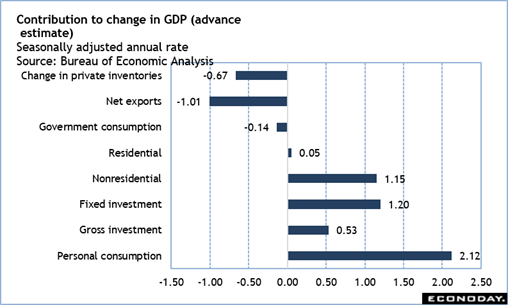
While the first read on growth in the second quarter is somewhat disappointing, it should be remembered that it is based on an incomplete set of data and some assumptions. There were ongoing economic disruptions in April from March following the start of the war on Iran on February 28. Notable in the components in GDP is a resurgence in consumer spending of up 3.2% in the second quarter from up 0.5 percent in the first quarter. Some of this will be due to higher prices for energy that fed into both consumer goods and transportation costs for businesses. Also notable is that there were some supply chain disruptions that meant a decline in inventories and a widening in net exports. Finally, although investment in nonresidential construction continues to boost gross investment, the pace of fixed investment is a bit slower at up 8.4 percent in the second quarter after up 10.6 percent in the first quarter.
The modest GDP increase in the second quarter does not contradict the FOMC’s assessment of recent growth as running at a “solid pace”. Nor should it raise hopes that a slowdown in the expansion will preclude the possibility of a rate increase when the FOMC next meets on September 15-16. As long as the economy maintains labor supply roughly in balance with demand, a single quarter of growth at 1.5 percent will not affect the bigger picture for monetary policy. It is inflation and inflation expectations that could tip the FOMC decision from no change to a rate hike. There’s a lot of data on the labor market and prices between now and then.
The FOMC decision on July 29 was not a surprise. That there were three dissents in the vote was more than anticipated. That one-third of the voter favored a 25 basis point increases suggests that there is currently significant support among all 19 FOMC participants for an increase in rates to address upward inflation pressures. Chair Kevin Warsh reiterated the FOMC’s commitment and determination to fulfill the mandate for price stability several times during his press conference. However, as he has previously indicated, under his watch, there will be no forward guidance about the future for rates. Rather, he will let markets make their own judgments about what the FOMC is likely to do. At the moment, markets are signaling anticipation of tighter monetary policy with higher rates and doing some of the Fed’s work for it.
One or two dissents in an FOMC vote are not that uncommon and can indicate when the direction of monetary policy is less certain. Three dissents are rate and point to a situation of greater uncertainty. The last time there were three dissents in the votes was at the December 2025 meeting when the majority voted for a rate cut of 25 basis points and Governor Stephen Miran preferred a cut of 50 basis points and Presidents Jeffrey Schmid of Kansas City and Austin Goolsbee of Chicago wanted no change in rates.