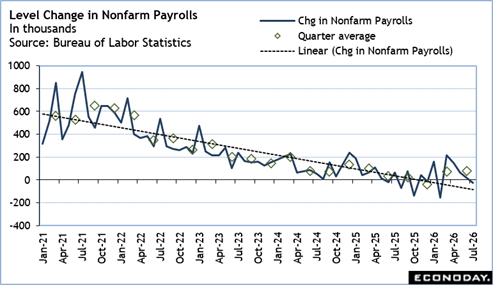
The July employment report delivered a shock to the downside with a decrease of 23,000 in nonfarm payrolls which was made even worse by a net downward revision of 103,000 to the prior two months. July can be difficult to survey because of vacation periods. However, the July survey period was 5 weeks long in 2026 and probably captured a fairly complete picture of hiring and firing over the course of the month. It is a weak start for the labor market in the third quarter compared to the monthly average of 77,000 in the second quarter and 73,000 in the first quarter.
Private payrolls eked out a 30,000 gain, it was mainly in two narrow sectors. Construction added 22,000 jobs and healthcare and social assistance was up 23,000 – both which have seen chronic shortages of skilled workers. The retail sector continued to contract with a loss of 19,400 jobs and leisure and hospitality payrolls are down 40,000 which is likely due to the end of the celebrations around the 250th anniversary of the Declaration of Independence.
Government jobs fell 53,000 and was mostly due to cuts of 49,600 in local government education at the end of the fiscal year.
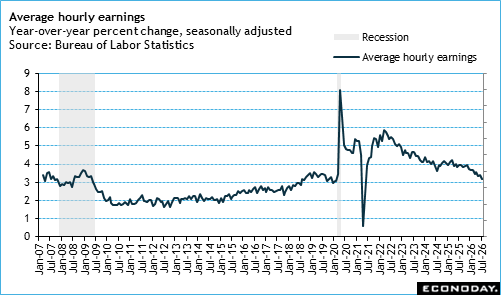
Average hourly earnings edged up 0.1 percent in July from June and are up 3.2 percent compared to a year ago. The year-over-year rise is the slowest since up 2.3 percent in May 2021. One month is not a trend but it looks like wage gains are in danger of not keeping pace with inflation.
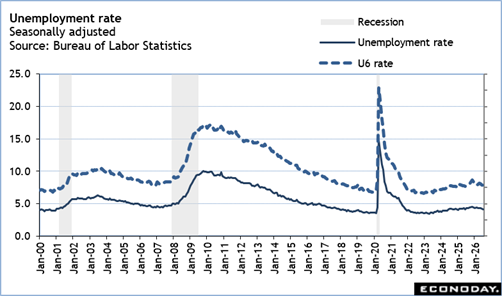
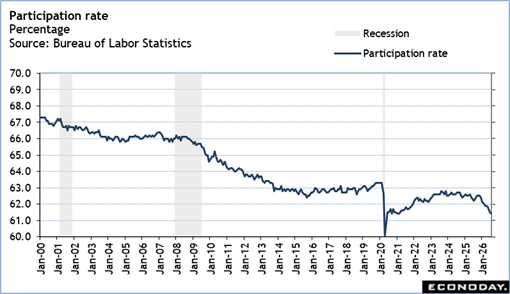
The unemployment rate of 4.1 percent in July is the lowest since 4.1 percent in July 2025. The size of the labor force shrank 264,000 to 169.094 million in July and reflected 87,000 fewer employed and 178,000 fewer unemployed. The participation rate was down a tenth to 61.4 percent to its lowest since 61.4 percent in February 2021. Labor supply is tight, especially for workers with the right experience. Between retirements and loss of immigrant labor, the pool of works is shallow. However, labor demand seems to be maintaining the precarious balance that Fed policymakers are closely observing.
After the disappointment of the advance estimate of second quarter GDP of up 1.5 percent, signs of slowing in the labor market sets up anticipation of another softer quarterly performance for the July-September period.