At first glance the April employment report looks of a piece with the recent data of a balanced job market with modest demand for labor against a shrinking labor supply. In many respects it is more confirmation of the resilience of the US economy against a backdrop of geopolitical uncertainty. However, the details in the report make that balance look precarious. There are a few hints of worsening conditions in the labor market at a time when the economic and geopolitical consequences of the war on Iran are beginning to pass through the data.
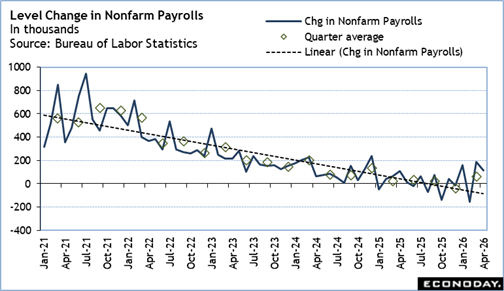
The 115,000 increase in nonfarm payrolls in April loses some shine with a 16,000 net downward revision to the prior two months. Nearly half the April gain can be attributed to adding 53,900 jobs in healthcare and social assistance. The healthcare sector has been the one steady light in hiring in recent months, but even that will eventually dim. Where new job growth will take place is uncertain, especially with rapid adoption of AI tools eliminating many other service positions.
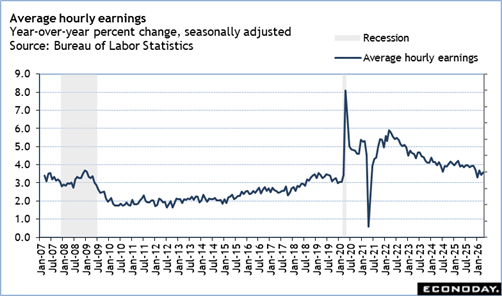
Average hourly earnings are moderating to small month-over-month increases. April and March both show a 0.2 percent rise. The hefty year-over-year increases in earnings are pointing to less competition for workers, although this is far from absent, especially for those with the right skills and experience. Average hourly earnings are up 3.6 percent in April from a year ago which is faster than the up 3.4 percent in March. However, the increases in the first four months of 2026 are more aligned with the readings seen in early 2020.
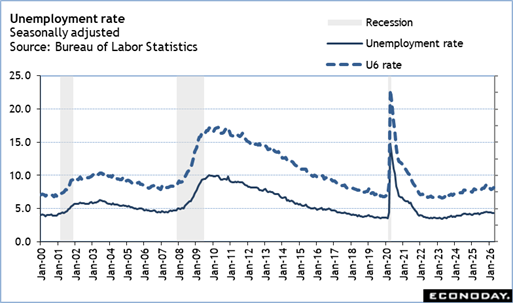
The steady unemployment rate of 4.3 percent in April and March would not suggest that the labor market is deteriorating. For the most part that is accurate. However, the two-tenths increase in the U-6 rate to 8.2 percent indicates that the workers least attached to the labor market – from lack of skills or education, inability to work full-time, or otherwise looking for work but unable to find it – is a signal that job opportunities are more limited. Some of these workers could withdraw from the labor force entirely.
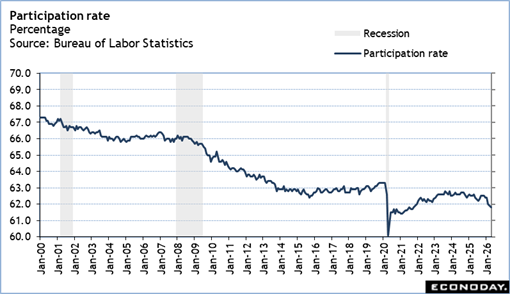
The labor force participation rate of 61.8 percent in April ticks down for a third month in a row. This is the lowest rate since 61.8 percent in October 2021 when the labor market was working its way back from the effects of the pandemic closures. The 92,000 decrease in the labor force to 169.995 million reflects a decrease of 226,000 in the number of employed and a 134,000 increase in the number of unemployed.
The number of people working part-time for economic reasons is up 445,000 to 4.942 million in April. A rise here is associated with households either needing extra income or taking part-time employment because no full-time work is available. The number of job losers is up 108,000 to 3.511 million in April. The number of people voluntarily quitting is down 54,000 to 844,000. New entrants to the labor force are up 91,000 to 805,000 in April. Taken together, this is a picture of a cooler job market with more reason for workers to feel discouraged about their prospects for employment.