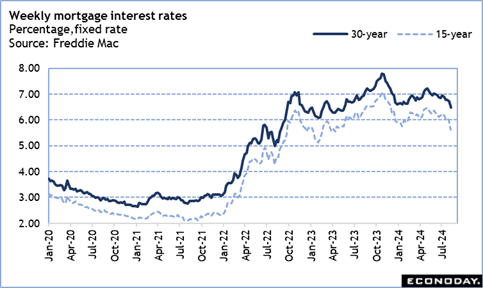
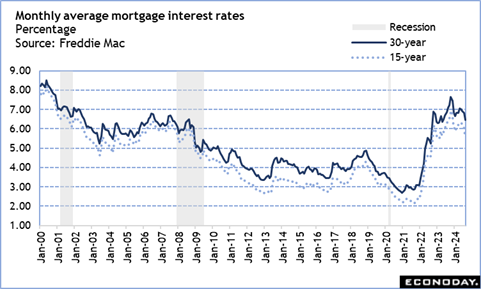
As of the August 8 data, the Freddie Mac rate for a 30-year fixed mortgage rate is down 26 basis points to 6.47 percent from the prior week, reaching its lowest since 6.39 percent in the May 18, 2023 week. The rate for a 15-year fixed rate mortgage is down 36 basis points to 5.63 percent in the August 8 week, below 6 percent for a second week in a row and the lowest since 5.75 percent in the May 18, 2023 week.
At least some of the week-over-week drop in rates can be attributed to markets overreacting to the July employment report which was a downside surprise in terms of weaker payroll growth and higher unemployment rates. The kneejerk response to the report elicited anticipation that the FOMC would act sooner than the September 17-18 meeting. That hope was quickly dashed. More recent data suggest that concerns about a downturn in the economy are exaggerated, although the labor market has indeed softened a bit and overall growth is likely to be modest in the third quarter 2024.
In any case, there may be a one-week upswing in applications for new mortgages and mortgage refinancing to take advantage of a narrow window of opportunity. Mortgage rates are likely to retrace much of the week-to-week decline – but maybe not all – in the August 15 Freddie Mac report on average mortgage rates. Those able to get a mortgage lock in the first days of August may result in a miniboom in refinancing activity and fuel some purchases of homes later in August and September. Those not able to get a favorable rate will probably continue to wait for another opportunity to get a more affordable fixed rate.
The outlook for mortgage rates will depend on the size and timing of future rate cuts when the FOMC releases its summary of economic projections along with the FOMC statement after the September meeting. Cuts on the scale of 50 basis points are unlikely, but there could be hope for another rate cut as soon as December and perhaps for reducing restriction monetary policy somewhat faster than previously anticipated.